Wallets2 min read
Backing Up a TRON Vanity Private Key
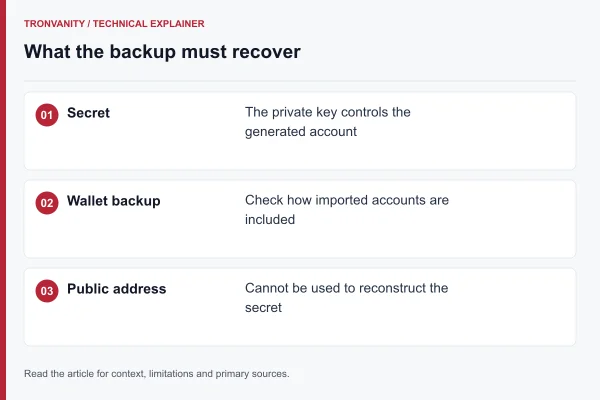
Save the exact private key returned with your result. The generator does not provide a seed phrase or a recovery service.
Practical TRON guides to pattern selection, hosted generation, private-key imports, backups and network account state.
Featured guide
Save the exact private key returned with your result. The generator does not provide a seed phrase or a recovery service.
Read the guideWallets2 min read
Save the exact private key returned with your result. The generator does not provide a seed phrase or a recovery service.
Wallets2 min read
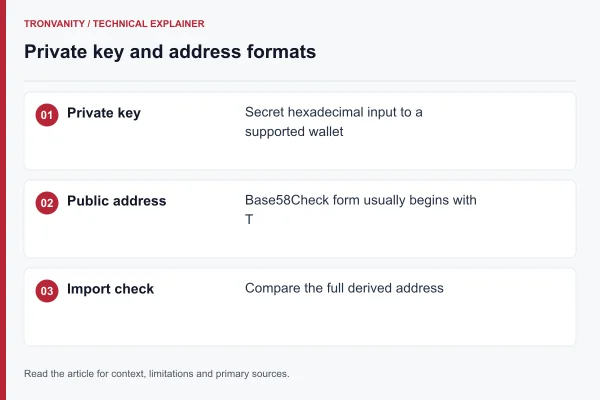
The result contains a TRON address and a 64-character hexadecimal private key. These are different fields and must not be interchanged.
Address format2 min read
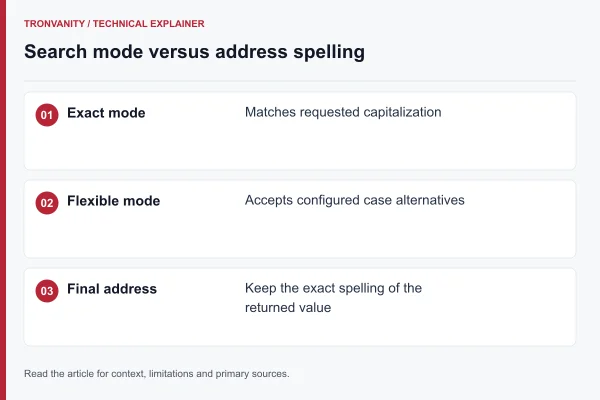
Base58 distinguishes uppercase and lowercase characters. Ignoring case broadens pattern matching without changing the returned address.
Generation2 min read
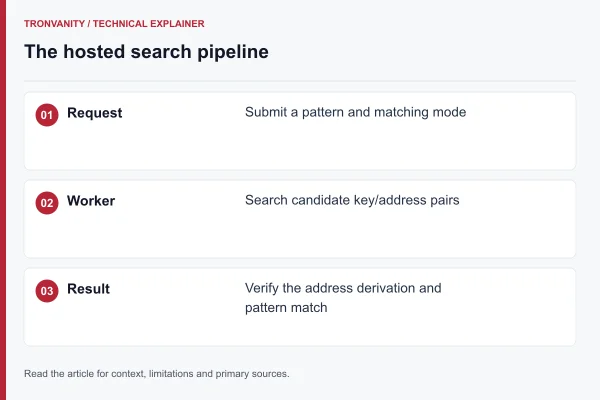
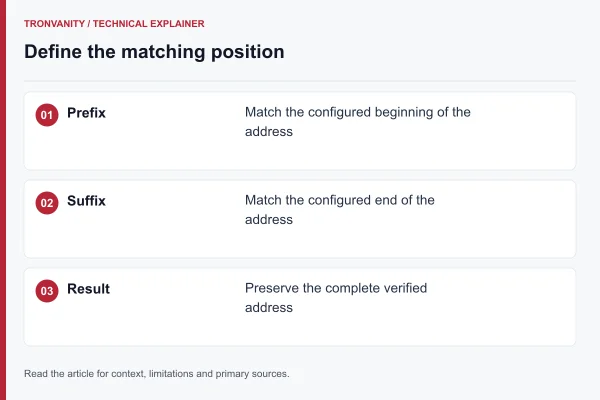
A worker searches private keys, derives their addresses and stops when an address matches your prefix or suffix. TRON Base58Check addresses begin with T.
Generation2 min read
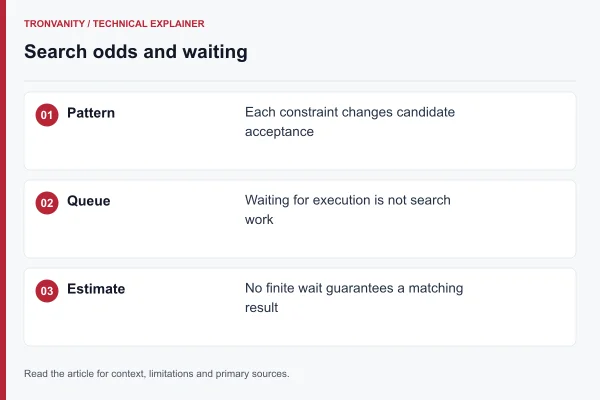
Longer patterns are harder to match. A search is probabilistic, so an average number of attempts is not a deadline.
Generation3 min read
Set up a TRON vanity address search: enter a prefix after T or a suffix, check Base58 characters, choose case rules and understand job status.
Generation2 min read
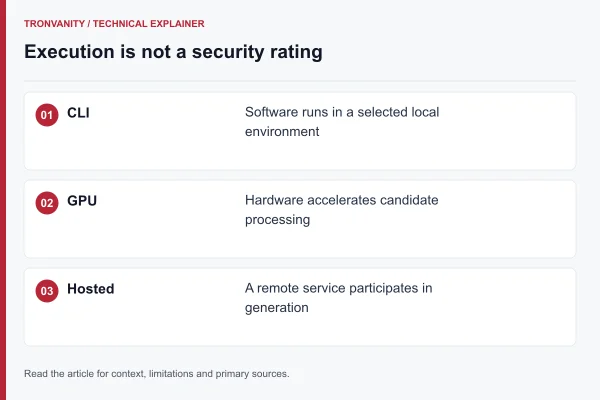
Compare generators by where keys are created, what engine they run and how their output is verified. Speed alone is not enough to assess a tool.
Security2 min read
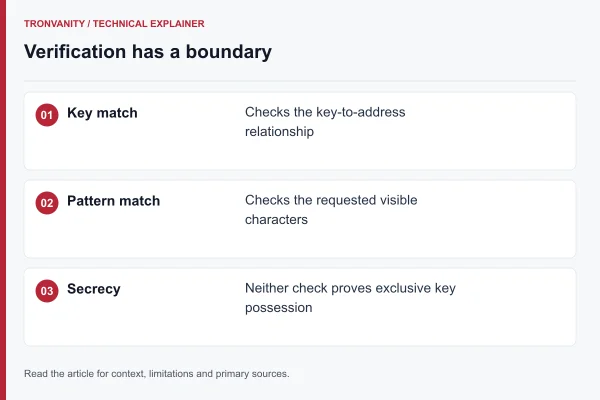
A vanity pattern is a visual preference, not a security property. The generation method and private-key handling determine the trust required.
Networks2 min read
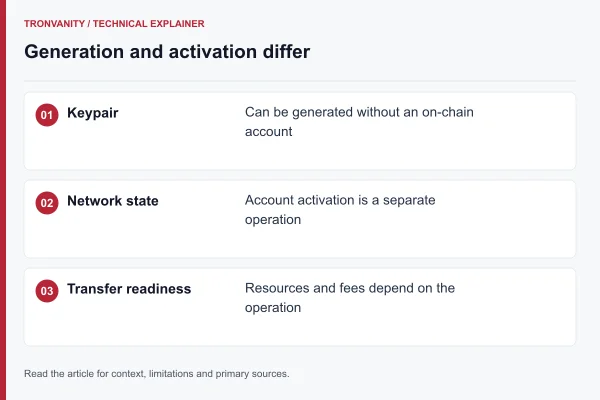
Generating an address does not activate an account on a network or submit a transaction. Key generation and on-chain account state are separate.
Keys2 min read
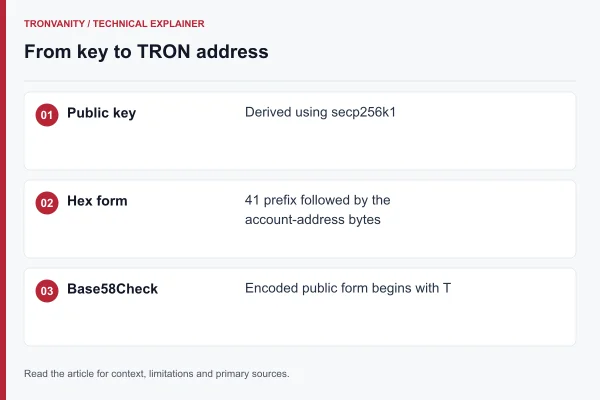
TRON uses secp256k1 key pairs. The familiar 34-character T address is a Base58Check representation of an address with version byte 0x41.
Each article includes an original diagram, a full-size SVG and a downloadable PNG. The diagram summarizes the article; the linked primary sources and limitations provide the context. When referring someone to a diagram, share the article URL so they can read that context too.