
Generation
TRON Vanity Address Difficulty: Odds and Time
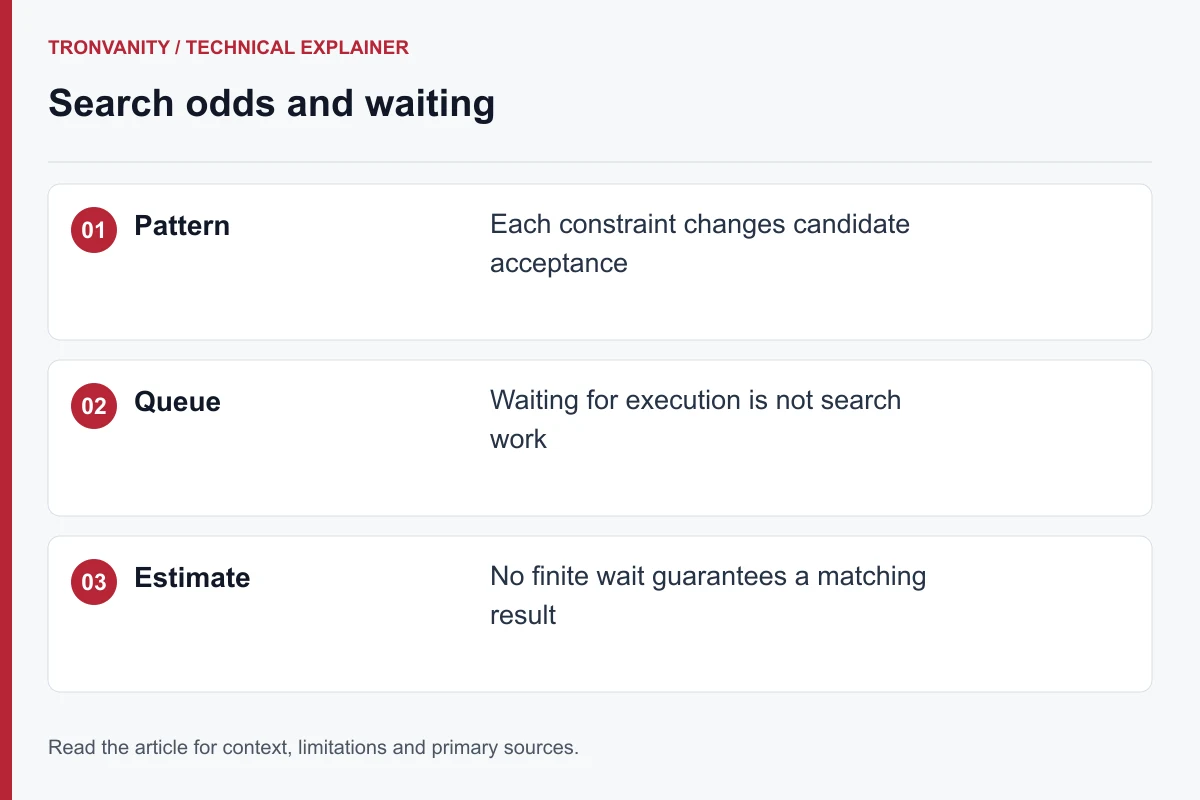
Longer patterns are harder to match. A search is probabilistic, so an average number of attempts is not a deadline.
Valid letters can still form an impossible prefix
The first T and the range of possible following characters come from TRON’s address encoding. A string can use only valid Base58 characters yet lie outside the allowed leading range. The worker checks prefix feasibility before starting the search.
A suffix has a different constraint because it is matched at the end of the encoded result. Changing to suffix mode changes the question being searched; it is not a guarantee of an instant result.
Why a longer pattern usually takes more work
In an idealized model with equally likely independent Base58 positions, another fixed character multiplies the candidate space by 58. Real prefixes have encoding constraints, so that rule is not an exact per-pattern estimate. Case-insensitive matching may accept several variants, depending on the chosen letters.
Search duration is random. Even a known average candidate count would not specify when one job must finish. Available hardware, worker startup and queueing also affect elapsed time.
Change the request deliberately
Begin with a short valid pattern and choose exact case only when its spelling matters. If a job exceeds your intended wait, cancel it and wait for the provider’s response. A result may complete before cancellation takes effect.
The case-sensitivity guide explains accepted variants, while the workflow guide distinguishes pending, completed and cancelled outcomes. This site does not guarantee a completion time for eight-character patterns.
Explore the related mechanism
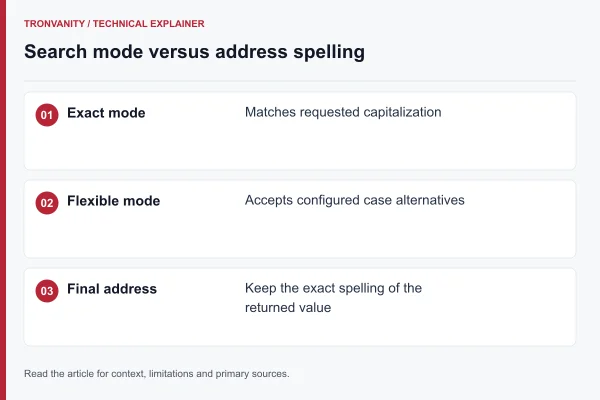
- Case-Sensitive and Case-Insensitive TRON Patterns — Base58 distinguishes uppercase and lowercase characters. Ignoring case broadens pattern matching without changing the returned address.
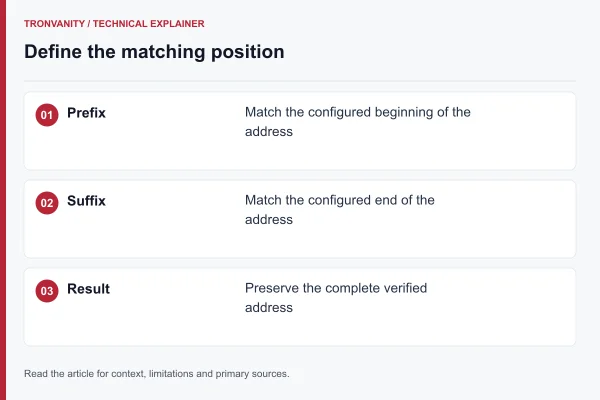
- TRON Vanity Search: Prefix and Suffix Guide — Choose one prefix or one suffix of up to eight Base58 characters. Use a short pattern first to verify the complete workflow.
- Open the complete workflow guide to place these checks in order.
- Open the address generator when you have chosen a compatible format and pattern.
Sources and editorial method
The technical references below support the concepts discussed in this article. Examples and comparison worksheets are explanatory, not measured service benchmarks.
Read next
Address format2 min read
Case-Sensitive and Case-Insensitive TRON Patterns
Base58 distinguishes uppercase and lowercase characters. Ignoring case broadens pattern matching without changing the returned address.
Generation3 min read
TRON Vanity Address Search: Prefix, Suffix and Case Examples
Set up a TRON vanity address search: enter a prefix after T or a suffix, check Base58 characters, choose case rules and understand job status.
Generation2 min read
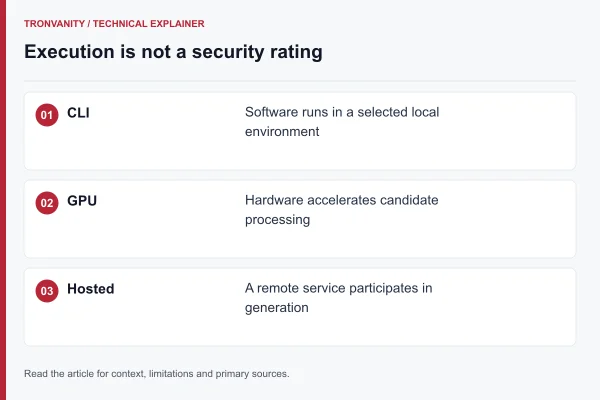
TRON Vanity Generators: CLI, GPU and Hosted Tools
Compare generators by where keys are created, what engine they run and how their output is verified. Speed alone is not enough to assess a tool.
Generation2 min read
How TRON Vanity Address Generation Works
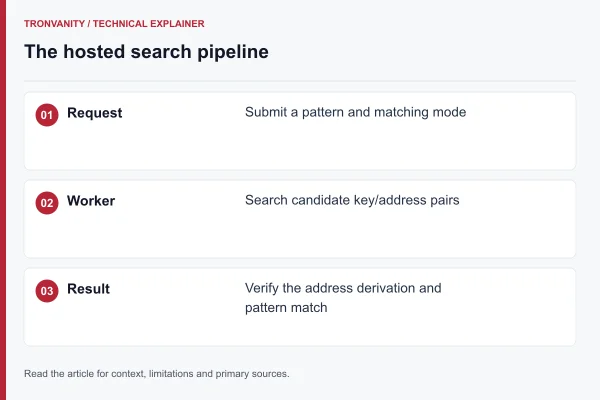
A worker searches private keys, derives their addresses and stops when an address matches your prefix or suffix. TRON Base58Check addresses begin with T.