
Address format
Case-Sensitive and Case-Insensitive TRON Patterns
Base58 distinguishes uppercase and lowercase characters. Ignoring case broadens pattern matching without changing the returned address.
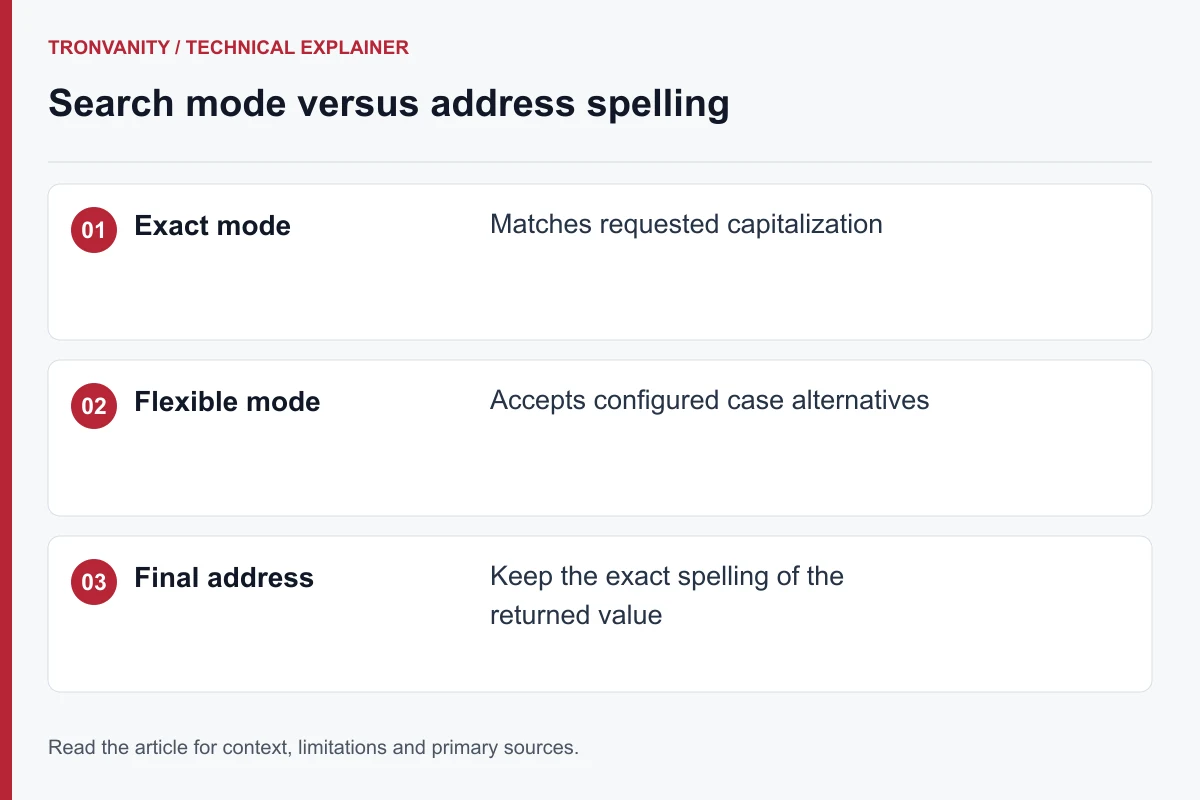
Uppercase and lowercase are different Base58 symbols
Base58 uses both cases but omits visually ambiguous characters: zero, uppercase O, uppercase I and lowercase l. Consequently, not every letter has two accepted case variants. An input containing an excluded symbol is not rescued by switching off case sensitivity.
For example, A and a are both valid symbols. Uppercase L is valid while lowercase l is not. Think of the input as symbols from a specific alphabet, not arbitrary text.
Ignoring case changes the search comparison
Case-insensitive mode allows candidate patterns whose letters differ in case where valid. It can increase the set of acceptable results. Exact-case mode accepts only the requested spelling. Neither mode changes the fixed network marker or the checksum rules.
Do not edit the returned address to force your preferred capitalization. The generated string is the destination. Modifying a character changes the encoded value and may make the checksum invalid.
Decide whether the spelling matters
Use exact case when the visual pattern must retain a particular form. If recognition is enough, case-insensitive matching can accept more outcomes. It still does not guarantee a completion time or make every leading pattern feasible.
Read the prefix feasibility and difficulty guide for those limits. The search walkthrough shows how to submit a request and handle its completed result.
Explore the related mechanism
- TRON Vanity Address Difficulty: Odds and Time — Longer patterns are harder to match. A search is probabilistic, so an average number of attempts is not a deadline.
- TRON Vanity Search: Prefix and Suffix Guide — Choose one prefix or one suffix of up to eight Base58 characters. Use a short pattern first to verify the complete workflow.
- Open the complete workflow guide to place these checks in order.
- Open the address generator when you have chosen a compatible format and pattern.
Sources and editorial method
The technical references below support the concepts discussed in this article. Examples and comparison worksheets are explanatory, not measured service benchmarks.
Read next
Generation2 min read
TRON Vanity Address Difficulty: Odds and Time
Longer patterns are harder to match. A search is probabilistic, so an average number of attempts is not a deadline.
Generation3 min read
TRON Vanity Address Search: Prefix, Suffix and Case Examples
Set up a TRON vanity address search: enter a prefix after T or a suffix, check Base58 characters, choose case rules and understand job status.
Keys2 min read
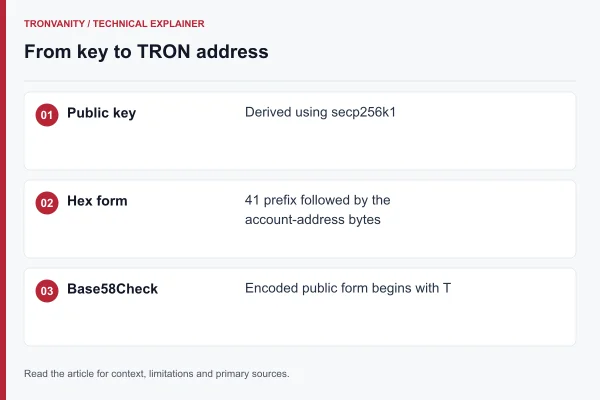
TRON secp256k1 Keys and Address Formats
TRON uses secp256k1 key pairs. The familiar 34-character T address is a Base58Check representation of an address with version byte 0x41.
Wallets2 min read
Backing Up a TRON Vanity Private Key
Save the exact private key returned with your result. The generator does not provide a seed phrase or a recovery service.