
Keys
TRON secp256k1 Keys and Address Formats
TRON uses secp256k1 key pairs. The familiar 34-character T address is a Base58Check representation of an address with version byte 0x41.
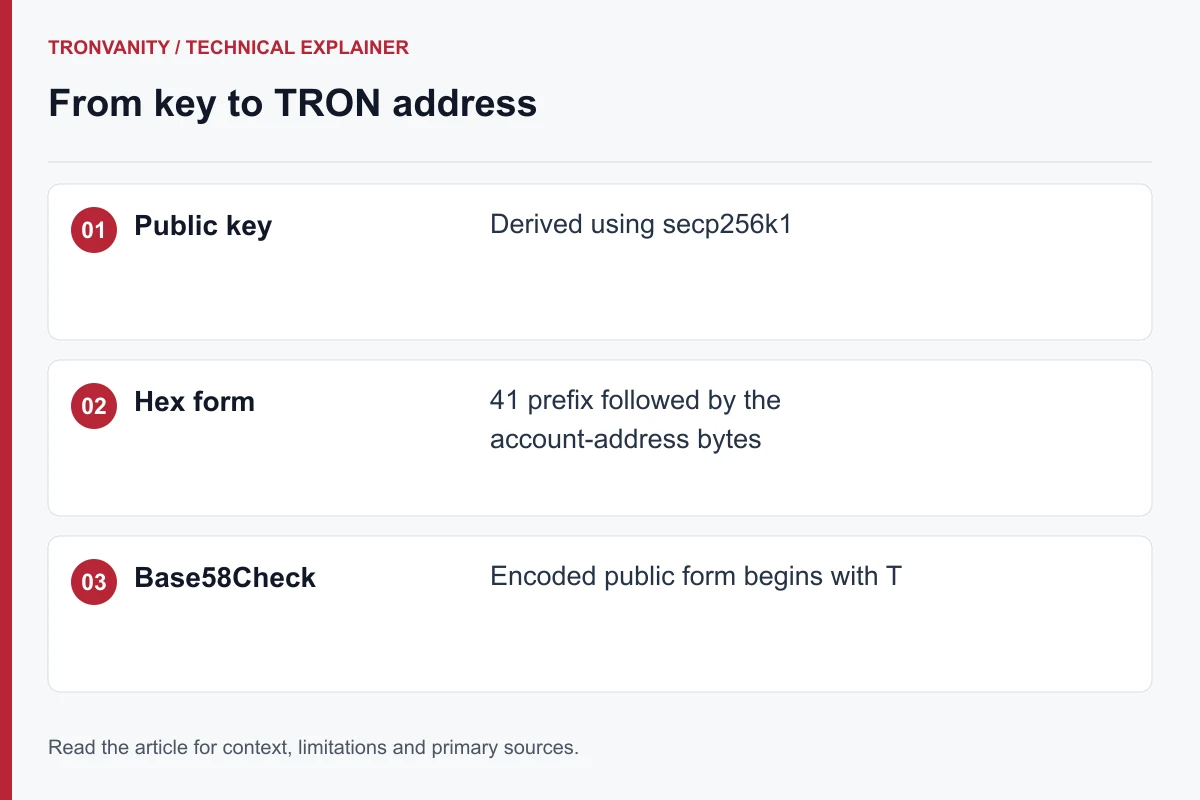
The key, public key and address serve different roles
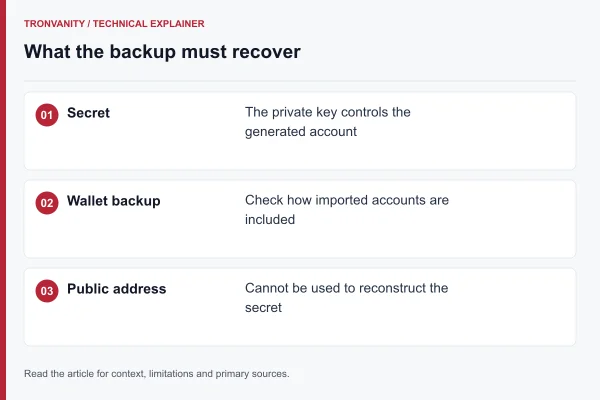
A TRON private key is a secret scalar used for signing. A public key is mathematically derived from it. An address is then derived from public-key data and encoded for use by wallets and APIs. Knowing an address is not equivalent to possessing its private key.
TRON uses the secp256k1 curve. The familiar Base58Check receiving representation has 34 characters and begins with T; the hexadecimal address representation instead includes the 41 version prefix.
How the public address is formed
Address derivation hashes the uncompressed public-key coordinates with Keccak-256, takes the final 20 bytes, and adds the 0x41 version byte. A checksum and Base58 encoding produce the wallet-facing string. The public-key serialization marker is not part of those coordinates.
A hexadecimal address and a hexadecimal private key are both text encodings of bytes, but their role and length differ. Do not substitute one into an API field intended for the other.
Why the service derives the result again
The worker checks the engine’s exported secret by independently deriving its address and verifying the pattern. This detects output inconsistency before reporting success. It does not by itself certify the engine’s entropy or prove that a secret remained private.
See the verification and hosting limits and how to recognize the exported fields. The algorithm explains address formation, while the wallet handles the subsequent signing workflow.
Explore the related mechanism
- How TRON Vanity Address Generation Works — A worker searches private keys, derives their addresses and stops when an address matches your prefix or suffix. TRON Base58Check addresses begin with T.
- Importing a TRON Vanity Private Key into a Wallet — The result contains a TRON address and a 64-character hexadecimal private key. These are different fields and must not be interchanged.
- Open the complete workflow guide to place these checks in order.
- Open the address generator when you have chosen a compatible format and pattern.
Sources and editorial method
The technical references below support the concepts discussed in this article. Examples and comparison worksheets are explanatory, not measured service benchmarks.
Read next
Generation2 min read
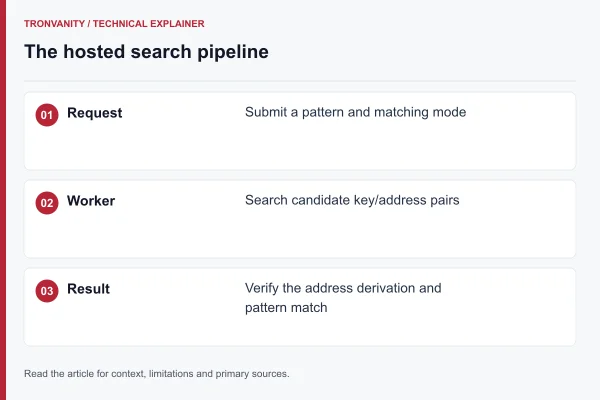
How TRON Vanity Address Generation Works
A worker searches private keys, derives their addresses and stops when an address matches your prefix or suffix. TRON Base58Check addresses begin with T.
Wallets2 min read
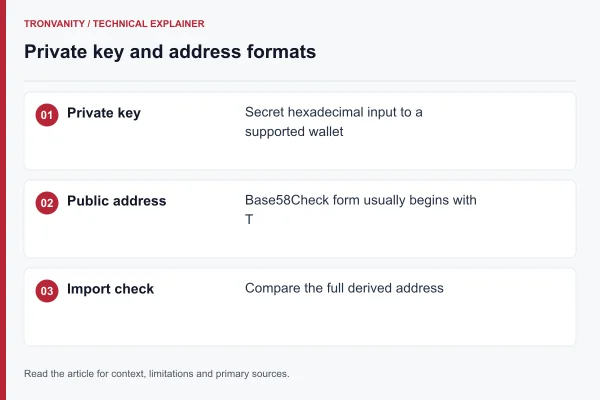
Importing a TRON Vanity Private Key into a Wallet
The result contains a TRON address and a 64-character hexadecimal private key. These are different fields and must not be interchanged.
Networks2 min read
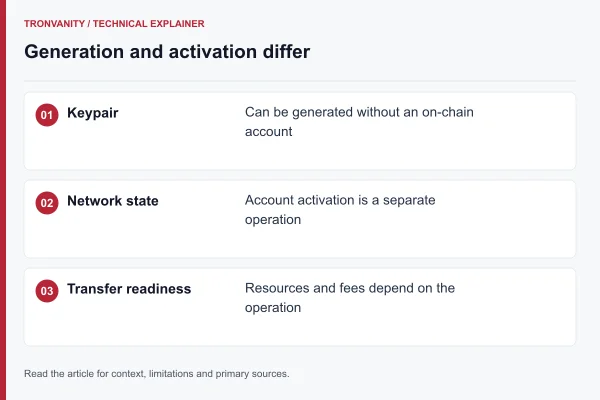
TRON Networks and Account Activation
Generating an address does not activate an account on a network or submit a transaction. Key generation and on-chain account state are separate.
Wallets2 min read
Backing Up a TRON Vanity Private Key
Save the exact private key returned with your result. The generator does not provide a seed phrase or a recovery service.