
Generation
How TRON Vanity Address Generation Works
A worker searches private keys, derives their addresses and stops when an address matches your prefix or suffix. TRON Base58Check addresses begin with T.
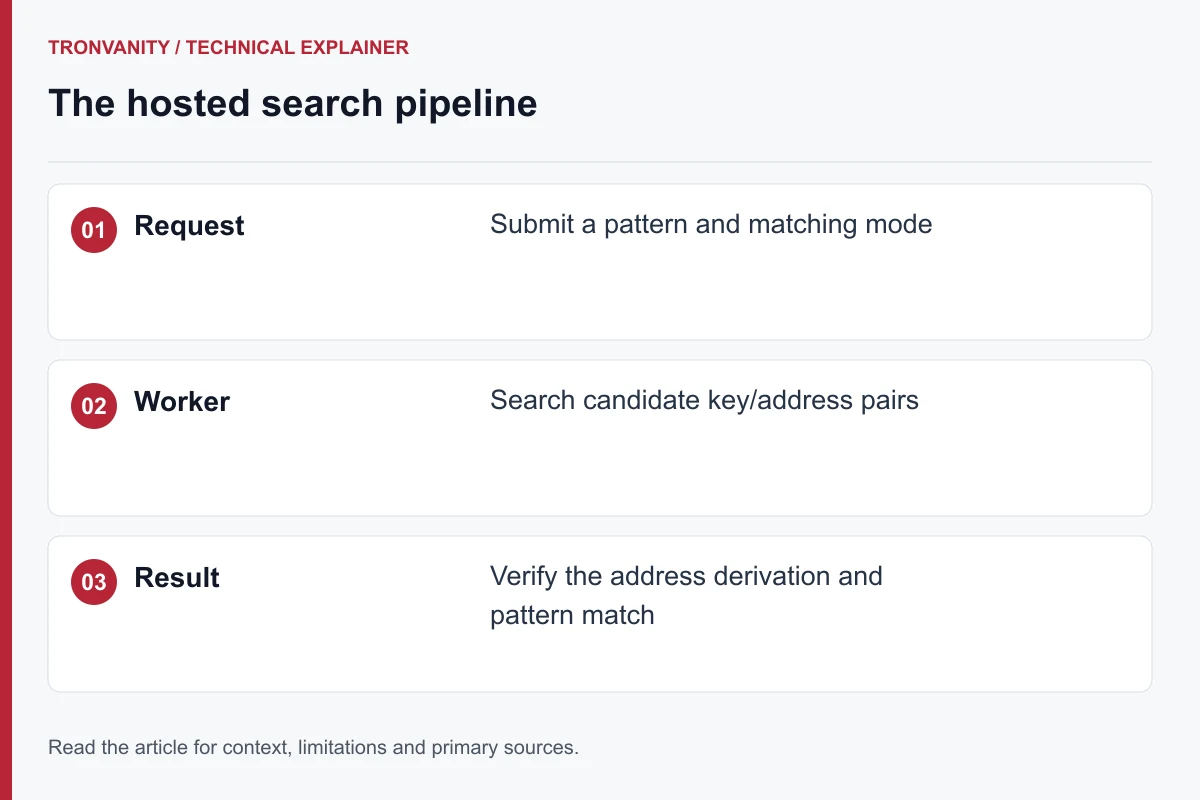
The worker searches keys, not account names
The requested text is a condition applied to candidate addresses. The worker repeatedly derives addresses from private keys until one matches. It cannot add a word to an existing account while preserving that account’s key.
This service returns a Base58Check TRON address and a hexadecimal private key. The T at the beginning belongs to the address format; the chosen pattern follows that marker for a prefix, or occurs at the end for a suffix.
What happens after you start
The browser submits a job through this site after its security check. A server-side RunPod worker performs the search. The interface polls job status and displays a result only after the worker verifies the returned key/address relationship and match.
Queueing and search time are different delays. Keep the result page open so you can save the private key. Repeatedly pressing start is not a way to accelerate an existing job.
Generation stops before on-chain activity
A successful match does not transfer TRX, activate a network account or create a seed phrase. Read the account activation explanation and the wallet import guide for the next steps.
For input choices and cancellation behavior, follow the search walkthrough. A recognizable pattern is a visual choice, not proof of a recipient’s identity.
Explore the related mechanism
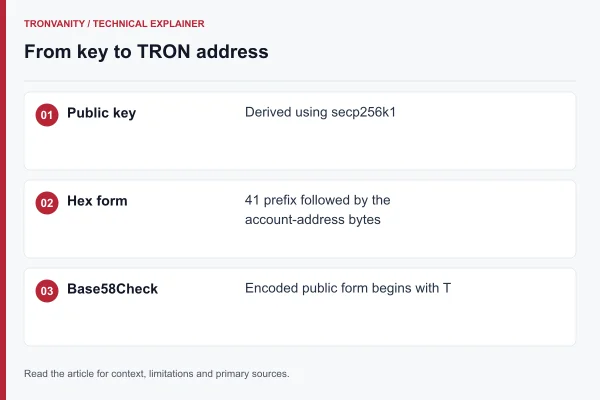
- TRON secp256k1 Keys and Address Formats — TRON uses secp256k1 key pairs. The familiar 34-character T address is a Base58Check representation of an address with version byte 0x41.
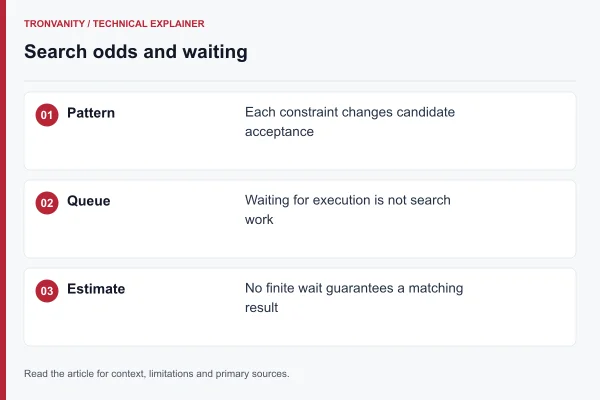
- TRON Vanity Address Difficulty: Odds and Time — Longer patterns are harder to match. A search is probabilistic, so an average number of attempts is not a deadline.
- Open the complete workflow guide to place these checks in order.
- Open the address generator when you have chosen a compatible format and pattern.
Sources and editorial method
The technical references below support the concepts discussed in this article. Examples and comparison worksheets are explanatory, not measured service benchmarks.
Read next
Keys2 min read
TRON secp256k1 Keys and Address Formats
TRON uses secp256k1 key pairs. The familiar 34-character T address is a Base58Check representation of an address with version byte 0x41.
Generation2 min read
TRON Vanity Address Difficulty: Odds and Time
Longer patterns are harder to match. A search is probabilistic, so an average number of attempts is not a deadline.
Generation3 min read
TRON Vanity Address Search: Prefix, Suffix and Case Examples
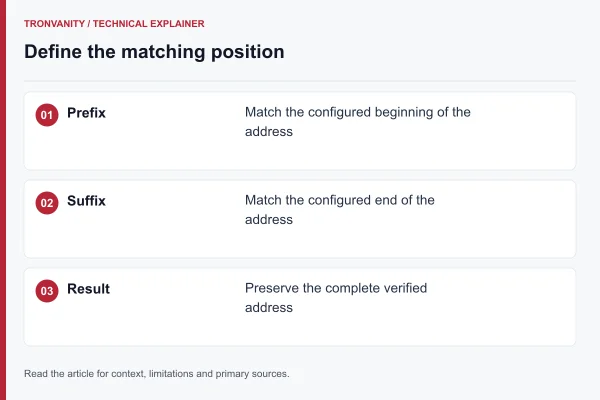
Set up a TRON vanity address search: enter a prefix after T or a suffix, check Base58 characters, choose case rules and understand job status.
Generation2 min read
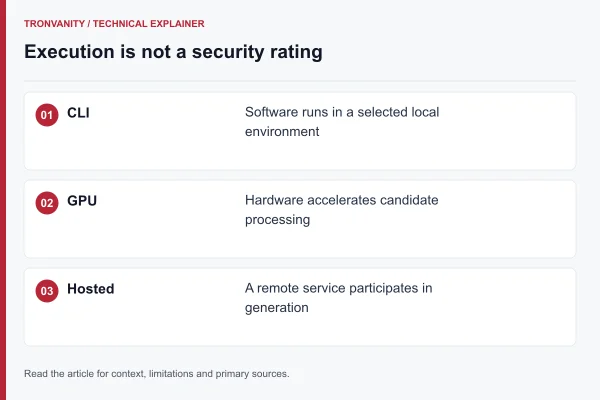
TRON Vanity Generators: CLI, GPU and Hosted Tools
Compare generators by where keys are created, what engine they run and how their output is verified. Speed alone is not enough to assess a tool.